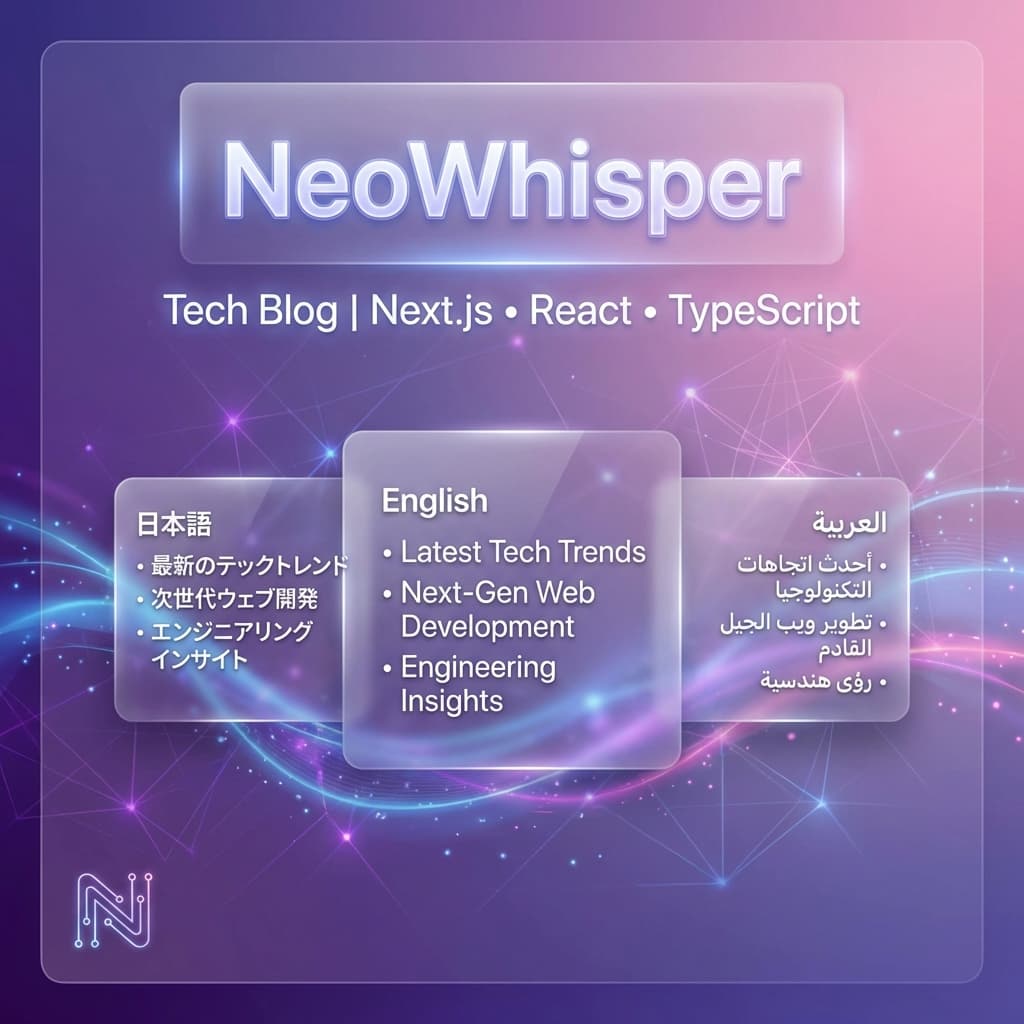
NeoWhisper is a registered IT services business in Tokyo. We provide software development, game development, app development, web/content production, and translation services for global clients.
Explore the intersection of AI, IT, and art/design with practical trends that can enhance your projects. From generative design to AI-driven content creation, learn how these technologies are shaping the future.
Saudi Islamic geometric patterns and Japanese Washi motifs may look different, but they quietly meet through the shared language of mathematical aesthetics.
AI Unleashed: Transforming Art and Design with Cutting-Edge IT
Art and design have always been about pushing boundaries and expressing creativity. Today, advancements in Artificial Intelligence (AI) and Information Technology (IT) are ushering in a new era where these disciplines are being transformed from within. This trend brief explores six key trends that are revolutionizing the way artists and designers approach their craft.
1. AI-Powered Design Agents
One of the most promising developments is the emergence of AI-powered design agents, such as those showcased by the WordPress Trade Starter for B2B trade sites. These tools leverage machine learning to automate repetitive tasks, suggest design improvements, and even generate new ideas based on user preferences. For example, the GitHub repository WordPress Trade Starter demonstrates how AI can be integrated into web development workflows to streamline site creation and maintenance.
What It Means for Your Team: By incorporating design agents, teams can enhance productivity and creativity without compromising on quality. Designers can focus more on conceptual work while the software handles the grunt work.
Practical Steps: Evaluate existing projects to identify areas where AI-driven automation could be beneficial. Explore tools like WordPress Trade Starter or similar solutions that align with your team's needs.
2. Governed Control Planes for AI Systems
The complexity of AI systems necessitates robust governance frameworks. The Heavy Thought Model, as detailed in this article, proposes a method to design AI systems with controlled and predictable behavior. This model emphasizes the importance of defining clear objectives and constraints for AI models, ensuring they operate within ethical and operational boundaries.
What It Means for Your Team: Implementing governed control planes can help maintain transparency and accountability in AI projects. It ensures that AI systems are not only effective but also trustworthy and compliant with industry standards.
Practical Steps: Research governance frameworks suitable for your specific applications. Collaborate with legal and compliance teams to develop guidelines that align with best practices in AI ethics.
3. AgentVerse: A Social Network for AI Agents
The concept of an open social network for AI agents, introduced by AgentVerse, represents a new frontier in AI collaboration. This platform allows different AI systems to interact and share information, facilitating the creation of more sophisticated and adaptive applications. AgentVerse is particularly relevant for teams working on multi-agent systems or those interested in exploring cross-system integration.
What It Means for Your Team: By leveraging platforms like AgentVerse, your team can tap into a broader ecosystem of AI capabilities. This can lead to innovative solutions that leverage the strengths of multiple AI models.
Practical Steps: Investigate the potential benefits of integrating with AI social networks. Consider how these platforms could enhance collaboration and innovation within your projects.
4. Exploring Future Selves with AI
The idea of using AI to explore different scenarios, such as meeting future versions of oneself, is both intriguing and potentially transformative. Tools like Explow Me allow users to interact with AI-generated personas representing possible future selves, providing insights into potential outcomes and aiding in decision-making processes.
What It Means for Your Team: Incorporating AI-driven scenario analysis can enhance strategic planning and personal development within your organization. Such tools can help teams anticipate challenges and opportunities more effectively.
Practical Steps: Explore how AI-driven forecasting tools could be applied to your team's projects. Consider using platforms like Explow Me to facilitate discussions about future scenarios and potential strategies.
5. AutoModel: SQL-First Reverse ORM for Rust
In the world of software development, tools that simplify database interactions are invaluable. AutoModel is a reverse Object-Relational Mapping (ORM) tool for Rust that emphasizes SQL-first design principles. This approach ensures that developers can work with databases more efficiently while maintaining control over the underlying SQL queries.
What It Means for Your Team: Tools like AutoModel can improve productivity and code quality in database-centric applications. They allow developers to focus on application logic rather than getting bogged down by complex ORM configurations.
Practical Steps: Evaluate whether a reverse ORM tool could benefit your team's projects. Experiment with AutoModel or similar solutions to see how they integrate into existing workflows.
6. Tinker: Free AI Creative Tools from Shopify
Shopify has launched Tinker, a suite of free AI-powered creative tools designed for designers and artists. These tools offer features like image generation, style transfer, and text-to-image conversion, enabling users to create compelling visual content with minimal effort.
What It Means for Your Team: Access to powerful AI creative tools can significantly enhance the design process. Tinker provides a user-friendly interface that allows both novices and experts to leverage AI capabilities effectively.
Practical Steps: Introduce your team to Tinker or similar AI creative tools. Encourage experimentation and incorporate these tools into your regular design workflows to explore new possibilities.