Table of Contents
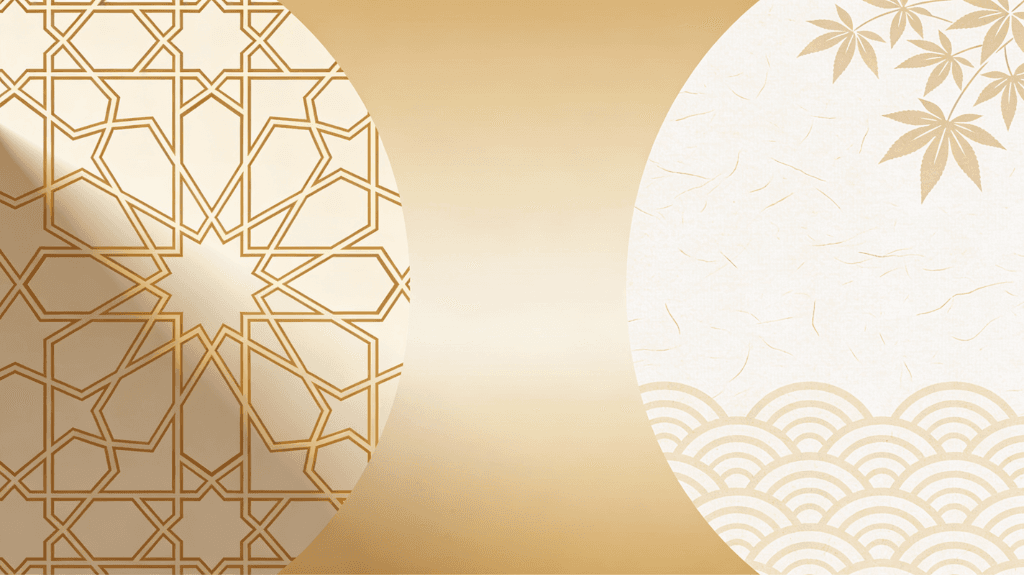
Intricate geometric patterns on the walls of a mosque in Riyadh. Delicate Washi motifs around temples in Kyoto. At first glance, these traditional arts seem completely different, yet they share surprising common ground.
Both traditions express infinity, echo the hidden order of nature, and hold a quiet spirituality. Islamic geometry hints at the boundlessness of Allah, while Japanese patterns point to the cycles of nature and a sense of cosmic harmony.
In this article, we switch between the eyes of a mathematician and a designer to see how desert geometry and Washi patterns resonate with each other across cultures.
1. Islamic Geometry: Drawing Infinity in the Desert
The geometric patterns in Riyadh mosques are built from circles, polygons, and star shapes arranged with high precision. Using only a compass and straightedge, artists create fields of strict symmetry and repetition that visually feel infinite.
In Islamic art, directly depicting the divine is avoided, so geometry becomes a symbolic language. Endless chains of stars and polygons suggest an expanding universe, evoking divine unity and cosmic order without a single figurative image.
From a math point of view, these designs rely on rotational and reflective symmetry, tilings, and carefully chosen proportions. They are like Euclidean geometry diagrams, not on a blackboard, but living on walls, domes, and light.
2. Washi Patterns: The Rhythm of Nature on Paper
Japanese Washi patterns express another way of seeing the universe through nature. Motifs such as seigaiha (layered waves), asanoha (hemp leaves), and kikkō (tortoise shell) symbolize calm continuity, growth, and stability through simple geometric forms.
Washi is unique because fibers and patterns overlap to create a surface that feels soft and alive. Even with the same pattern, the look changes with light and distance; morning light, evening light, and indoor light each pull out different moods.
For designers, Washi patterns are built on yohaku (intentional empty space) and gentle irregularities. Instead of perfect symmetry, tiny shifts, fading ink, and slight noise give the pattern a human, living character.
3. A Mathematician’s View: One Language of Patterns
Seen through mathematics, Islamic geometry and Washi share one clear language: symmetry and tessellation. Islamic art pushes star polygons and tile divisions to high complexity, while Japanese motifs repeat simpler shapes with subtle changes.
In both, a global pattern grows from simple local rules. A hexagonal grid can evolve into complex stars on a mosque wall, just as repeating hemp leaves or waves can create a visual field that feels endless on paper.
In this sense, a desert mosque wall and a Kyoto screen are both visualized algorithms. The “code” is written in lines and shapes; each culture just chooses different starting shapes and constraints.
4. A Designer’s View: Patterns as Spiritual UI
Design-wise, these patterns act like spiritual user interfaces for space. In a mosque, dense geometry spreads the gaze, calms personal thoughts, and guides attention toward a shared spiritual center, supporting a focused atmosphere for prayer.
Washi patterns, used in shoji or interior panels, soften light and blur the line between inside and outside. They create a gentle transition zone where everyday reality feels slightly muted, making it easier to turn inward and reflect.
If we translate this into modern UI/UX language, Islamic geometry feels like a precise grid and layout system, while Washi works like texture and micro-noise that adds warmth. Both tune the user’s mental state, just with different visual tools.
5. Connecting Riyadh and Kyoto in Future Design
With today’s tools, these traditional patterns are no longer “just old motifs”. They inspire generative art, procedural design, and digital textures in apps, games, and interactive installations.
You can imagine a pattern engine that uses a classic Riyadh mosque grid, then renders it with Washi-like fibers and Japanese colors. Or an installation where Islamic stars slowly morph into Japanese waves as you move through the space.
Desert geometry and Japanese Washi were born in different religions, climates, and histories. Yet both come from the same human impulse: to understand the world through patterns. By looking with both mathematical and design eyes, we may see not only the shapes, but also the shared spirit drawn between their lines.
Further Reading
Interested in bringing cultural patterns into your digital projects? At NeoWhisper, we combine traditional aesthetics with modern technology to create unique design experiences. Explore our projects or get in touch to discuss your vision.